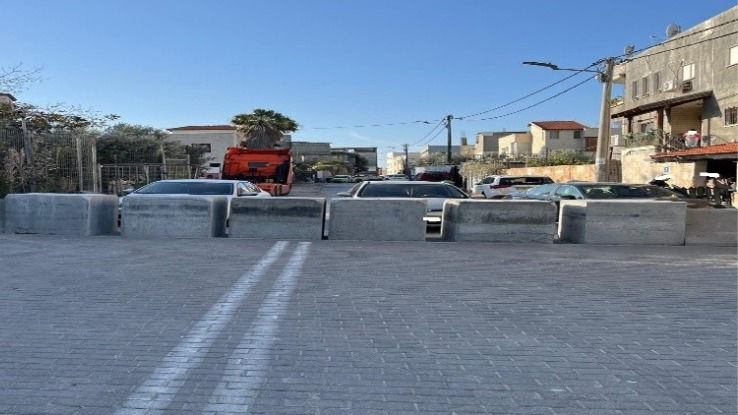
Roadblocks Cutting Off Arab Neighborhoods in the City of Lod
Photos: Abeer Joubran, ACRI
On February 1, 2026, ACRI petitioned the Supreme Court on behalf of four residents of the city of Lod, demanding the removal of concrete roadblocks placed by the police in two of the city's neighborhoods that are home to hundreds of Arab residents. In one neighborhood, the concrete barrier has completely sealed off the area; there is no other way to enter or exit. In the other neighborhood, the alternative road passes through an industrial area that is difficult to access and whose infrastructure is damaged. The blockades cause serious disruptions to daily life, prevent access to emergency services, and violate the human rights of the residents of the neighborhoods, including the right to freedom of movement, dignity, health, life and body integrity, education, and equality.
The petition argues that this is a continuation of the discriminatory and illegal policy adopted by the police in recent months, of placing concrete barriers at the entrance to Arab settlements or in their neighborhoods. There is no legal basis granting the police the authority to cut off neighborhoods and towns for extended periods of time, and the police evade judicial review by removing the barriers after a petition is filed against them. Once the barriers are removed, the court then states that the petition has become “theoretical,” and therefore there is no need to hold a hearing; the police are then able to continue with these illegal activities.
After the petition was filed, the police quickly moved the roadblocks in both neighborhoods, allowing vehicles to pass (the roadblocks remained in place on the sides of the road). On February 3, 2026, we asked the court to order the police to submit a response and to schedule a hearing on the petition. As mentioned above, this is a recurring incident in which the police stop violating human rights after a petition is filed, thus receiving "immunity" from judicial review.
In its preliminary response, the police claimed that the roadblocks were removed before the petition was filed, and that the petition is therefore theoretical and should be rejected. ACRI's response asserted that the roadblocks were not removed before the petition was filed, and that the concrete roadblocks in one of the neighborhoods are still on the side of the road and obstruct traffic. ACRI emphasized that the petition also refers to the issue of the lack of an explicit source in the law that grants the police the authority to place roadblocks in Arab localities and neighborhoods, and that the practice is a result of the interference of the Minister of National Security in operational decisions by the police.
We also noted that the police continue to place roadblocks in various Arab localities such as Salem, A'eblin, and Segev Shalom.
On July 6, 2026, the Supreme Court held a hearing on the petition. During the hearing, the justices expressed doubts about the existence of a legal source granting the police the authority to place concrete barriers in Arab localities, and noted that this kind of serious violation of human rights requires explicit legal authorization. The State responded that it was formulating a new procedure, and the judges asked to examine the procedure before issuing a decision.
In early August, the police submitted an updated notice in which it based the policy on the general police powers granted under the law, and stated that it would continue to use these kinds of neighborhood blockades. ACRI's response made clear that the general powers granted to the police do not allow it to impose prolonged roadblocks blocking entire neighborhoods or communities; imposing this kind of serious disruption requires explicit authorization and clear criteria for implementation.
The Supreme Court issued a conditional order on September 1, 2026, ruling that the police must explain "why they will not refrain from placing rigid, unguarded
roadblocks as described in the petition, without express legislative authorization to do so." The police were required to respond by October 4, 2026.
HCJ 4388-02-26 ACRI v. Israel Police
Attorneys: Abeer Joubran, Nitsan Ilani
ACRI's petition, February 1, 2026 (Heb)
Request on behalf of the petitioners, February 3, 2026 (Heb)
Preliminary response from the police, February 2026 (Heb)
Petitioners' response, March 2026 (Heb)
Petitioners' request for an urgent hearing, April 2026 (Heb)
Petitioners' updated notice, June 2026 (Heb)
Supplementary response from the police, July 2026 (Heb)
The decision (conditional order), September 1, 2026 (Heb)
For a full list of legal correspondence and articles (Heb), see here.