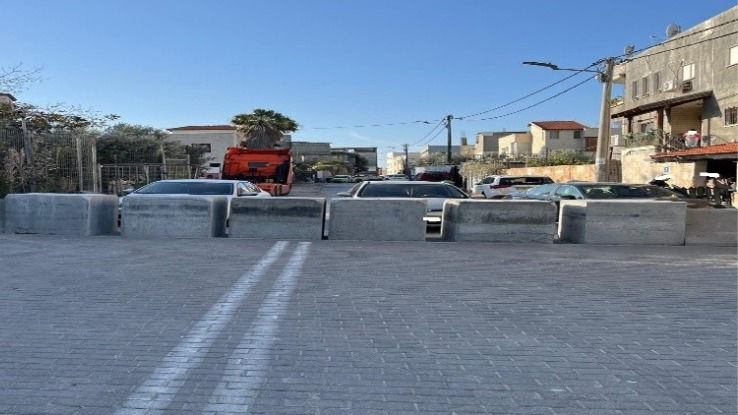
Transparency in Imposition of Movement Restrictions

The Association for Civil Rights in Israel, Physicians for Human Rights, Yesh Din, B'Tselem, and HaMoked Center for the Defense of the Individual petitioned the Supreme Court on February 13, 2025, demanding that the military and the head of the Civil Administration regularly publish orders that impose movement restrictions on Palestinians in the territories.
The petition explains that without transparency, movement restrictions are imposed chaotically and arbitrarily, with no oversight of the decision-making process. The military often denies the existence of checkpoints and curfew orders that are meanwhile being enforced by soldiers in the field, or enforces arbitrary restrictions that settlers impose in the area in order to restrict the movements of Palestinian residents.
Since the map of restrictions is dynamic, residents cannot know which apply to them and when, and cannot plan their movements accordingly. Restrictions on movement, whether by limiting or blocking access to roads or towns, can dramatically affect daily life: individuals leave home not knowing if they will reach their destination, when they might arrive, or whether they will subsequently be able to return. It also limits access to basic necessities, including food, water, medical care, agricultural lands for farming, work and school, and meeting family members and friends. In the worst case scenario, denying access to basic life necessities can be fatal.
The petition argues that the policy of imposing movement restrictions on Palestinians in the West Bank infringes on residents' human rights, prevents them from accessing essential services, and subjects them to oppression and policing without any official accountability, documentation, or responsibility. At a minimum, the military is obligated to act in accordance with the law and to update and inform the residents under its protection where checkpoints are positioned. The petition also noted that the duty to publish travel closures and restrictions is especially important when dealing with an occupied population that has significantly less power than the authorities, and that already struggles to safeguard and insist on its rights in encounters with police and the military.
In its preliminary response to the petition, the military argued that there was a security justification for not publishing movement restrictions more broadly, but that they were published sufficiently and available in various locations, including Palestinian headquarters, police stations in the settlements, and at checkpoints. ACRI's response explained that the petition to force more transparency in the imposition of movement restrictions only referred to orders that are permitted to be published, and we were not arguing for publication of confidential orders. Currently, Palestinians do not have reasonable access to information about these movement restriction orders, and no way of reviewing how decisions were made or their legality.
A hearing was held in October 2025, after which the court asked the State to clarify how it would fulfill its obligation to publish movement restriction orders such that the Palestinian population subject to those restrictions would receive the information. The State responded in February 2026 that solders would spray paint the letter "Z" on roadblocks and checkpoints. This proposed "solution" is patently absurd, which we noted in our response in March 2026.
ACRI submitted a request on April 28, 2026 to schedule an urgent hearing on the petition. In the request, we referred to a report from the United Nations Office for the Coordination of Humanitarian Affairs that found that the number of checkpoints reached a record high, with a 43% increase in the number of movement restrictions imposed in the West Bank.
HCJ 35304-02-25 The Association for Civil Rights in Israel v. Commander of IDF Forces in the West Bank
Attorney: Reut Shaer
The petition, February 13, 2025 (Heb)
For a full list of legal correspondence, see here (Heb).
The petition was written with the help of Elza Bugnet and field coordinator Muhannad Anati